New 65-townhome community planned for long-vacant Wilmington property
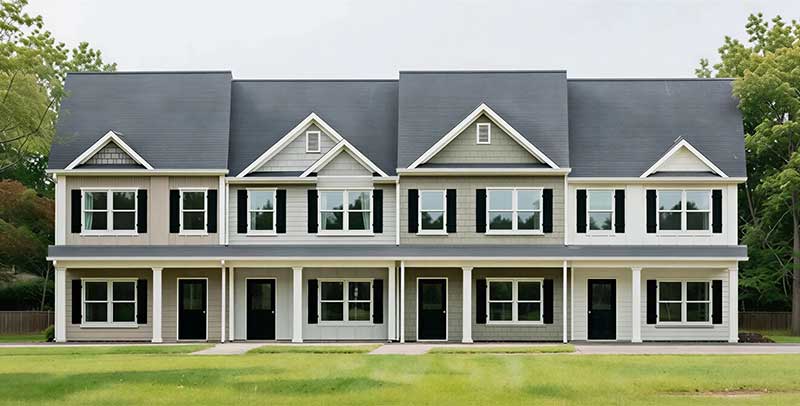
Photo courtesy of Rolina Homes
Editor’s note: This story was originally published by WilmingtonBiz and has been reformatted for readability and visibility on Good Life Wilmington.
A long-vacant property in Wilmington could soon look very different. Construction is expected to begin this fall on Covil Village, a new community that will bring 65 three-bedroom townhomes to a 5.4-acre site at 202, 310 and 314 Covil Ave.
The property was once home to Port South Village, an assisted living facility that closed in 2013. It has remained vacant for more than a decade. Developers are awaiting final permits and plan to break ground in early September, according to Andy Mitwol, managing director of Frying Pan Ventures LLC.
Key takeaways
- The bigger picture: A 5.4-acre Covil Avenue property that has sat vacant for more than a decade is being redeveloped into a residential community.
- The details: Covil Village will include 65 three-bedroom townhomes built in four phases.
- What’s next: Construction is expected to begin in September, with the townhomes slated for completion between March and August 2027.
- Why it matters: Developers say they want to create an approachable homeownership option while investing in a long-vacant part of Wilmington.
From vacant property to new housing
Mitwol and Clayton Williams, also a managing director of Frying Pan Ventures, identified the Covil Avenue property as a development opportunity about two years ago.
Securing the site took time. Over the years, the property had moved from one estate to another, into a family trust and then changed hands again.
Beginning in early 2024, the developers made calls and sent emails and letters as they worked to reach the owners. Once they connected, the owners were open to selling, and the group was under contract within six months.
Deed records show FPVRH Covil LLC purchased the properties for a combined $1.2 million in May. The LLC was created specifically to develop the project.
Plans changed after neighborhood input
As plans took shape, the development team met with Wilmington officials and residents of nearby Mercer Avenue.
Those discussions led to changes in the project, including:
- Preserving additional trees along Covil Avenue
- Enlarging the buffer between the development and homes on Mercer Avenue
The team also worked with Whit Beebe, division president of Rolina Homes, to develop cost estimates. Beebe later became a partner in the project.
Last spring, Wilmington City Council unanimously approved rezoning the property from an R-15 moderate-density single-dwelling district to an MD-17 (CD) high-density multiple-dwelling conditional district.
A proposed road project created uncertainty
Another consideration was the N.C. Department of Transportation's proposed Independence Boulevard extension.
The proposal called for a 1.7-mile stretch of new elevated roadway connecting the intersection of Independence Boulevard, Randall Parkway and Mercer Avenue to Martin Luther King Jr. Parkway. The roadway could have affected surrounding properties, including the Covil Village site.
When developers began planning the community, the road project's future remained unclear. Earlier this year, local transportation officials removed the project from the state's capital project plan.
When will Covil Village be built?
Rolina Homes will build the community in four phases.
The current timeline includes:
- September 2026: Groundbreaking expected
- Early 2027: Pad completion and vertical construction expected to begin
- March-August 2027: Townhomes expected to be completed
Intracoastal Realty will handle marketing and sales.
How much will the townhomes cost?
A specific price range has not yet been announced.
Developers said they want Covil Village to provide a more accessible opportunity for people looking to become homeowners.
“The core value here is approachable housing that lets people get a foot in the door,” Williams said.
Mitwol also described the development as an investment in a part of Wilmington that has been underused for years, saying the project could improve walkability and livability in the surrounding area.